Thursday, June 27, 2013

Grieving the Loss of Your Pet or Horse


In Episode 27, I chat with Rebecca Cagle, life coach, counselor and author of Grieving the Loss of Your Pet and Grieving the Loss of Your Horse

In this program, we discuss grieving the loss of a pet through trauma or illness; through natural causes - old age; through euthanasia; through loss in the event of theft or a pet’s wandering away or when a pet has to be given away or sold.

The questions addressed include: What added elements come into play when a pet has to be brought to a shelter knowing that the facility is a kill shelter? How can folks deal with guilt especially when a pet has been lost because of a family member's error or when an animal has to be given away because of an allergy or a mismatch with a family? Is it wise for parents to involve their younger children in decision making when it comes time to euthanize a pet or when a pet must be sold or given away? How should teenagers be involved in these decisions? What do you tell children when a pet has died? Do pets go to heaven?

Rebecca shares some stories of folks she’s assisted through the grieving process and offers advice on how individuals may help friends and family members move to a place of healing. She also brings alongside some of the key elements from her book, Grieving the Loss of Your Horse.

Friday, May 31, 2013

Choosing the Next Class for the Pawsitive Partners Prison Program


I spent a morning this week with folks from the Pawsitive Partners Prison Program at an animal shelter in Burgaw, North Carolina. The group was present to choose dogs to be trained in preparation for adoption into permanent homes. On this day, the kennels were full and it appeared to me there would be no problem in finding good candidates.

The program's director, Barb Raab, told me that most of the dogs coming into the shelter are hounds that have been used for hunting and pit bulls, used in fighting. North Carolina law prohibits organizations like Pawsitive Partners from bringing dogs of any breed deemed aggressive into their programs and pit bulls are on that no-train list.

As we walked along the outdoor kennels, some dogs snarled at us. Others cowered in corners. Several, however, either warily or eagerly, came near looking for attention. If a dog passed this initial assessment, referred to as "cage presentation," he or she was brought inside the shelter to undergo 18 more tests. Through these, the evaluators sought to get a sense of how the dog might respond to a tooth exam, a baby, a toddler, a cat, another dog, a loud noise, a hug, a toy, a food bowl. A doll and a stuffed animal stood in for the baby and toddler and the cats were safely secured out of reach.

If a candidate passed these evaluations, he or she was then tested for heartworm. I was saddened to see two delightful little dogs being returned to their cages when they were found to have high-antigen levels for the parasite.

Barb Raab, Founder and Director of the
Pawsitive Partners Prison Program,
working with one of the dogs under
consideration.
Just five animals would be selected this day for an eight-week round of training and these successful candidates will be put through their paces by specially-screened inmates at the Pender County Correctional Institution.

The fear in the eyes, the tension in the bodies, and the tightly-tucked tails made me wonder what kind of abuse some of the dogs I saw must have endured prior to being brought into the shelter. It delighted me no end to think how different their lives are likely to be once they are placed in loving adoptive homes.

Pawsitive Partners is credited with saving the lives of  canines but human beings are being transformed through their efforts as well. One of the program's volunteers told me he has never forgotten the words shared by one of the inmates after his first round of classes with the Pawsitive Partners dogs. The man said the experience marked the first time in his life he'd ever thought of anyone but himself and drugs.
These two dogs, having passed the temperament tests and heartworm
screening, will be participating in the next round of classes. Two other
dogs were not as fortunate; they passed all of the temperament
evaluations but had to be rejected due to high-antigen levels for
heartworm.

Thursday, May 30, 2013

All Things Snoopy

On October 2, 1950, three kids - Charlie Brown, Patty and Shermy - appeared on the funny pages of seven newspapers. Over the next 50 years plus - via television specials, a Saturday morning cartoon, books, live theater productions, recordings, amusement parks and 17,897 comic strips - these three, along with Snoopy, Woodstock and others in a sizable cast of characters, have taught us and entertained us.

The Peanuts Gang was the invention of Charles M. Schulz and, today, visitors to Santa Rosa, California may explore the art and nuances of his craft at a museum that carries on his legacy.
Schulz was born in Minneapolis in 1922 and 12 hours after his birth, an uncle gave him the nickname “Sparky” after the racehorse character Spark Plug in a popular comic strip of the time, Barney Google. Thus, almost from the moment of his birth, Schulz had a connection with comic strips. Early on, “Sparky” showed an aptitude for art and, following service in the European Theater of Operation during World War II, he launched into a career in the funny papers.
IMG_5705In Episode 26 of On the Road with Mac and Molly, I chat with Karen Johnson, Director of the Charles M. Schulz Museum and Research Center and longtime friend of the Schulz family. We hear about the Peanuts Gang, its creator and the museum. And then we center, most especially, on all things Snoopy from his doghouse decor (a pool table, Wyeths and a Van Gogh . . . ); to his impersonations (from a moose and a pelican to Mickey Mouse); his moments at the typewriter (“It was a dark and stormy night . . . “); his alter-egos (who doesn’t love his WWI flying ace and his battles with the Red Baron?); his “band of brothers” (siblings Spike, Marbles, Olaf, Andy and Belle); and his connection with aviation (from NASA to the U.S. Air Force).
It was not until 1957 that Snoopy walked on his two
hind feet like a human.
Karen explains how Snoopy’s character evolved over time to embrace more and more of the fanciful. We also hear why Schulz believed the best idea he ever had in the strip was to move Snoopy from inside the doghouse to the rooftop.
All photos taken at the Charles M. Schulz Museum and Research Center in Santa Rosa, California by Donna Hailson.

Friday, April 26, 2013

LCC K-9 Comfort Dogs Bring Peace and Healing to the Grieving in Boston and Texas

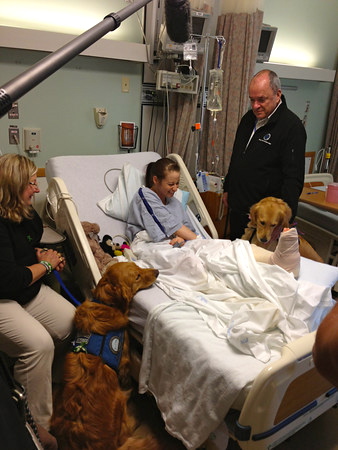
K-9 Comfort Dogs Ruthie and Luther, along
with team members Rich and Dona Martin,
visit with Lee Ann Yanni, a survivor of the
bombings in Boston, just before she under-
went surgery to repair her shattered leg.

After ministering to those shaken by the bombings along the route of the Boston Marathon, specially trained therapy dogs have been deployed to help those struggling to recover from the fertilizer plant explosion in West, Texas.

The dogs and their handlers are members of the Lutheran Church Charities K-9 Comfort Dog team that is headquartered just outside of Chicago. In Boston and in Texas, these Golden Retrievers and their handlers have come alongside victims, families, first responders, medical personnel, public works employees, school children and just folks on the streets who are in need of some unconditional love, non-judgmental ears, and what Tim Hetzner, President of the LCC, calls “furry counseling.”

Luther and Ruthie, bags packed, ready to deploy.
The program was born in 2008 in the wake of a number of tragedies including Hurricane Katrina and the shooting at Northern Illinois University. It began with only four dogs. Now there are 67. The dogs and their handlers were in Newtown, Connecticut following the shootings at the Sandy Hook Elementary School and they came alongside flood victims in Roanoke, Illinois. When they are not responding to a crisis, teams are deployed to hospitals, nursing homes, schools, and other places to make comfort visits.

Tim Hetzner, President of Lutheran
Church Charities. 
In Episode 24, I speak with Tim Hetzner, who led the team in West, Texas and who was also with the team deployed to Boston. Tim shares stories from the ministry in these cities and recounts how the dogs have been able to break through to help people move toward healing. Often, individuals will begin by petting the dogs and hugging them. Then the tears and the worry-filled and pain-filled words follow. 

While in Boston, the team spent time working at the First Lutheran Church which sits very near the finish line of the Marathon. The Wednesday Night Runners' Club of Boston, most of whom were marathoners from Monday's race, were among those who came by to talk through the events of the week and to work through their thoughts and feelings together as a group with the K-9 Comfort Dogs. Wherever the team went they helped provide a respite area, a place to step away from the fear and sadness to work through the healing process individually or in groups.

Home base for the team in Texas is Waco's St. Paul Lutheran Church but a good bit of the ministry has been done in the local schools and with university students shaken to the core by the disaster.
Bringing comfort.

Each of the dogs in the program, including those deployed to Boston and Texas, has its own Facebook page. Home page for all is: https://www.facebook.com/k9comfort?fref=tsFor more information on the Comfort Dogs visit: http://www.lutheranchurchcharities.org/index.php?option=com_content&view=category&layout=blog&id=25&Itemid=95.

All photos provided by Lutheran Church Charities.


Wednesday, April 17, 2013

Pawsitive Partners Prison Program


Photo provided by
Monty's Home
In Episode 25, the focus is on the Pawsitive Partners Prison Program, which is operated under the umbrella of Monty's Home. This North Carolina-based organization was inspired into being by the love and generous spirit of Monty, a dearly loved therapy dog and canine star who brought sunshine into the lives of many.

This precious golden retriever spent hours each week visiting nursing homes and hospitals in southeastern North Carolina and his remarkable ability to stir up joy in human hearts eventually brought him to the attention of the nation. After he succumbed to cancer, the love of his human companion, Barb Raab, led her to create an organization in his memory and today, through Monty's Home, sunshine continues to be shed on dogs and human beings through efforts like the Pawsitive Partners Prison Program.

In this episode, I chat with Barb who explains the process involved in selecting dogs from kill shelters to undergo training in preparation for adoption into permanent homes. We hear how, after undergoing temperament evaluations, heartworm testing, spaying/neutering, microchipping and vaccinations, each new "class" of dogs moves into the Pender Correctional Institution in Burgaw where they are trained by specially-screened inmates over a period of eight weeks. Upon graduation, the dogs go home to their adoptive families.

Goodbye Hug. Photo provided
by Monty's Home.
Nearly 100 dogs have been successfully placed in loving homes and preliminary nationwide studies are suggesting that the recidivism rate of inmates participating in programs of this type is significantly reduced. Pawsitive Partners is credited with not only saving the lives of canines but saving the lives of humans as well.

The episode begins with Barb's recounting of life with Monty and moves on through some of the high points and most memorable moments that Barb, program volunteers, dogs and inmates have experienced through Pawsitive Partners over the years.

Sunday, January 20, 2013

Allergies and the CritterZone

Bill Converse, Inventor
of the CritterZone
Air Purifier. Photo provided
by Air Restore.
In the third installment in a continuing series on “Threats to Pets,” I chat with Bill Converse, founder of Air Restore Inc. and inventor of the CritterZone Air Purifier. The CritterZone was recently awarded a first place among new products at the SuperZoo/National Show for Pet Retailers in Las Vegas.
Molly. Photo by Donna Hailson.
Bill and I begin our conversation discussing pet allergies and human allergies to pets. A number of questions are addressed: What causes allergies? What are some of the airborne irritants that especially give us trouble? What percentage of pets and humans suffer from allergies? Why are some individuals prone to allergies and others not? What are the symptoms of allergies in pets and how do veterinarians determine what allergens are the problem causers? What happens in the body when an allergen attacks? Do pets suffer from seasonal allergies as humans do? What about viruses; can dogs and cats catch the flu or the common cold? Can pets become hypersensitive to airborne particles when kept in the house all the time? And what are the environmental allergen concerns particular to RV travel?


Photo by Donna Hailson.
In the latter half of the program, Bill explains how new developments in ionic technology may help to naturalize the air within our homes, vehicles and other contained spaces by knocking out such irritants as dander and dust and breaking down odors around litter pans, cages and aquariums. The compact (less than 5 inches tall) CritterZone unit is filter-free, uses about 1/20th the energy used to power a 60-watt bulb, and Bill claims it can handle the air in an area of up to 800 square feet.

Air Restore's website offers an explanation of the technology behind CritterZone noting, first, that the air we breathe is filled with various contaminants (dust, dander, bacteria, dry protein from feces, mold, germs, viruses and more). It also contains the natural ingredients of the fresh air that Nature intended including oxygen, nitrogen, hydrogen, and water vapor.


CritterZone units. Photo provided
by Air Restore.
The company claims its product will "naturalize" the air, restoring natural air balances, in a way akin to the work of a thunderstorm. It is said to do so via two distinctly different, but related, continual processes: Bi-Polar Ionization & Plasma Conversion.

Air Restore's website continues with this: "Bi-Polar Ionization is a continual process whereby massive streams of positive and
 negative ions are released into the environment. These ions create charges on the solid
 matter in the air, which are then attracted to the particles of the opposite charge until 
they grow heavy enough to settle out of the air. As the air restores around the CritterZone,
 the process extends deeper into the environmental space, quickly cleaning a 
large area from a small source. The Plasma Conversion Process uses a high-energy plasma flow to convert the 
moisture in the air into natural cleaning agents. The moisture is converted to 
additional hydrogen and oxygen components and then proceeds to use these to create
 oxidation and reduction components in the form of hyper-oxides and hydroxides 
(HOH and OH) - the natural cleaners. These components react to pollutants, virtually
 destroying odors, mold, bacteria, germs, viruses, dust, dander, etc.  These same
 components combine with the moisture in the air to provide a surface of 
protection to actually PREVENT germ and mold growth."

Bill acknowledges that the CritterZone does produce trace amounts of ozone as a byproduct of this process. He concludes, however, that the amounts are less than minimal and the health benefits are substantial.


Wednesday, December 19, 2012

Diane Nelson of Wild Rivers Art

Diane Nelson with her critters at
the Wild Rivers Art Emporium.
Photo by Donna Hailson.
While traveling through Gold Beach, Oregon, I came across the handwork of Diane Nelson, a woman who has elevated the popular, widely practiced craft of crocheting to an art form. On display at the Wild Rivers Art Emporium on the city’s main drag, Highway 101, is found a menagerie of pelicans, starfish, dromedaries, aardvarks, wildebeests, camels, flamingos, turtles, lobsters, and octopi. Two of my favorite pieces (an underwater scene featuring a clown fish and a pair of frogs climbing a bit of driftwood) are pictured here. Diane begins each piece by fashioning a wire mold that is then covered with batting, and finished with the crocheted exostructure.
Photo by Donna Hailson.